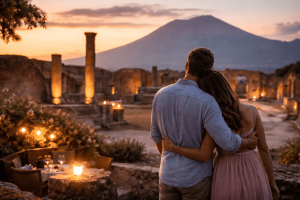
Who says that once you’ve visited the Pompeii excavations there’s nothing else to see? On the contrary, the modern town offers remarkable urban walks, corners rich in history, contemporary art, and natural landscapes worth exploring on foot. In this article, we guide you through Pompeii’s lesser‑known routes, perfect for extending your experience beyond the archaeological ruins and capturing the vibrant soul of today’s city.
Whether you’re a passionate walker, a curious urban explorer, or simply looking for some relaxation after visiting the Archaeological Park, you’ll find practical ideas and real walking routes to enjoy solo or with company. The beauty lies in the fact that everything is walkable—and you won’t need to stray far from the historic centre or your accommodation.
From the Sanctuary to the Sarno River: a stroll through sacred and natural spaces
Let’s start at one of the emblematic sites of modern Pompeii: the Shrine of Our Lady of the Rosary, a pilgrimage destination and the beating heart of the town. From here, main thoroughfares branch out—and quieter, evocative paths too. One of the most interesting leads to the Sarno River Green Park.
Along Via Carlo Alberto you reach Piazza Bartolo Longo, from which a pedestrian boulevard flanked by flowerbeds and trees winds past residential areas toward the river. Crossing Via Plinio and continuing on Via Ripuaria, you gain access to a newly revitalized stretch of the river park, where the Sarno River flows calmly amid reeds and greenery. An unexpectedly serene natural corner where herons, mallards, and other water birds can be spotted.
Ideal for a peaceful nature pause or photography enthusiasts, this walk also offers reflection on the environmental role of the river—which, once navigable, is now at the heart of ecological enhancement initiatives.
The historic market: colors, flavors & everyday life
If you love capturing the authenticity of places, don’t miss the Pompeii neighborhood market, held every Tuesday morning along Via Lepanto and nearby streets. Here, you can enjoy local produce, overhear conversations between vendors, and witness everyday gestures—telling the story of a lively, industrious Pompeii rooted in its traditions.
Seasonal fruits, traditional cheeses, fresh fish—but also clothing, utensils, and curiosities: a bustling microcosm perfect for those who appreciate popular atmospheres and details often overlooked in tourist circuits. A stroll among the stalls is the best way to truly feel the spirit of the place.
Read also: alternative itinerary within the excavations
Murals & urban art: Pompeii in color
Pompeii surprises with urban art. Throughout parts of the city—particularly between Via Nolana and Via Lepanto—you’ll find contemporary murals that reinterpret ancient myths, local stories, and sacred figures in a modern key. It’s a street‑art trail that dialogues with the past—perfect for lovers of photography and visual culture.
Among the most famous is the mural dedicated to Bartolo Longo, founder of the Shrine, alongside artworks celebrating Pompeian deities, Neapolitan female faces, and the victims of the 79 AD eruption. Each piece forms a fragment in an urban narrative that enriches your visit.
You can easily include this in an afternoon city stroll. And if you’re looking for ideas on events in Pompeii, keep an eye on local art showcases that often involve the urban scene.
Connections to nature trails toward Vesuvius
Pompeii also serves as a strategic base for walking enthusiasts. From peripheral neighborhoods (such as Tre Ponti), toward Torre Annunziata or Boscoreale, semi‑rural paths lead to trails within Mount Vesuvius National Park.
A particularly scenic route passes from Pompeii along Via Parrelle, continues via Via Andolfi, and heads toward paths leading to the Vallone della Profica and the Vesuvius Observatory. Geology and botany lovers would benefit from exploring information on Vesuvius and the flora & fauna of Vesuvius before setting off.
Guests staying in Pompeii can combine day‑hiking with discovering the volcano, its lesser‑known trails, and the seasonally changing landscapes. For those planning where to stay in Pompeii near the excavations—ideal for excursions—it’s best to choose accommodation close to the historic centre and the Circumvesuviana station.
Another Pompeii to discover—by walking
Pompeii isn’t just archaeology—it’s a living city, made of authentic glimpses, folk traditions, markets, gardens, artworks, and natural trails. Walking in Pompeii means opening your eyes to a heritage that lives on in the present—between spirituality, daily life, and urban beauty.
Whether you’re visiting for a day or longer, these itineraries will help you explore the city with a slow pace and curious mindset. A way to truly make Pompeii yours—off the beaten track but into the heart of its identity.
Widespread archaeological route: Pompeii beyond the excavations
Outside the Archaeological Park, Pompeii preserves little‑known but significant historical traces. In particular:
- Villa of Diomedes: visible from the outside, one of the largest Roman suburban villas, near Porta ERcolano.
- Street of the Tombs: connecting the eastern necropolis with ancient Roman roads outside the walls.
- Amphitheatre & Large Gymnasium: often overlooked by quicker tours, located in quieter areas—ideal for a more relaxed walk.
Gastronomic experiences along the way
An aspect not to be overlooked is the food stops:
- Ancient shops and small historic bakeries along Via Lepanto and Via Nolana offering taralli, wood‑baked bread and traditional sweets.
- Fruit & vegetable market: a chance to discover seasonal local produce.
- Family‑run trattorias on Via Roma and Via Sacra, where you can try dishes like gnocchi alla sorrentina, minestrone maritata and vegetables from the Nocerino area.
FAQ – Frequently Asked Questions
How far is the Shrine from the Sarno River?
Approximately 2 km on foot, flat route, walkable in 25–30 minutes.
Is the Pompeii market only on Tuesdays?
Yes—the main market is held every Tuesday morning, although small seasonal Sunday markets also occur.
Are murals only in the centre?
Most are between Via Nolana and Via Lepanto, but some can be found in more peripheral areas.
Are there maps or marked trails for the nature routes?
Yes—the Vesuvius Park website and Pompeii’s tourist information office offer up-to-date materials.
Can these walks be done with children?
The urban routes are family‑friendly, while those toward Vesuvius require assessment of physical ability and age suitability.