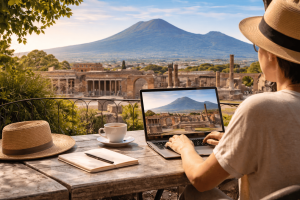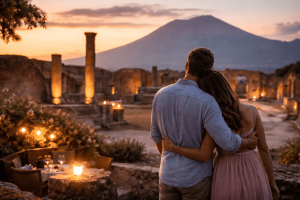
Once upon a time, there was a city full of life, colors, and delicious smells rising from Roman kitchens. A place where children played in the streets, merchants sold fresh fruit, and artists painted walls with bright, vivid frescoes. That city was called Pompeii, and it stood at the foot of a mountain everyone believed to be peaceful: Mount Vesuvius. But one day, long ago, that mountain awoke and changed the destiny of the city forever.
This is the story of Pompeii told to children — to discover together what life was like in one of the most famous cities in the world, and what truly happened on that distant day in 79 AD when Vesuvius erupted. A simple yet wondrous journey through time, helping young readers (and grown-ups too!) understand why Pompeii is still so special today.
Once upon a time in Pompeii: the city at the foot of Vesuvius
More than two thousand years ago, at the foot of Vesuvius, stood a lively and beautiful city. Its streets were paved with large stone blocks, and at its center was the forum, a large square where people gathered to shop, talk, and listen to public speeches. Pompeii was a true Roman city: it had temples, theaters, public baths, and even small shops selling freshly baked bread or warm bowls of lentils.
Children in Pompeii went to school just like today. They wrote on wax tablets and learned to read, count, and speak Latin. They played with spinning tops, small balls, and clay dolls. Families gathered in the evenings inside houses decorated with colorful mosaics to share stories about gods and heroes. Life was calm and simple, ruled by sunshine and the nearby sea — with Vesuvius standing behind the city like a gentle giant.
Who founded Pompeii and who lived there
According to historians, Pompeii was founded by the Oscans, an ancient Italic people. Over time, it came under strong Greek and Etruscan influence. During the Republican era, it experienced an important Samnite phase, and later became fully integrated into the Roman world as a Sullan colony after 80 BC. Each period left traces: the Greeks contributed temples and building styles, while the Romans added public baths and wide stone streets. Thanks to its position near the sea and fertile countryside, Pompeii grew rich through trade and agriculture, producing wine, oil, and dried fruit.
Pompeii did not have a king. It was governed by elected municipal magistrates, especially the duoviri and aediles. Life followed the laws of Rome. Wealthy aristocrats lived in grand houses with gardens, fountains, and beautiful wall paintings. Artisans and merchants lived in simpler homes, but still colorful and full of useful objects. Everyone shared a love for daily life — food, theater, and music.
Vesuvius, the sleeping mountain
Mount Vesuvius, which still towers over the region today, seemed like a peaceful mountain. Ancient writers were aware of signs of its volcanic nature, but no major eruption had occurred for many centuries. The people of Pompeii did not imagine that a “heart of fire” was hidden deep inside.
A volcano is like a large pressure cooker: inside, there is very hot, liquid rock called magma. When pressure becomes too strong, the magma rises to the surface and escapes as lava, ash, and gas. That is what happened at Vesuvius in 79 AD — on a day traditionally thought to be in August, but which many recent studies suggest was actually in late October. The exact date, however, is not 100% certain.
The day of the eruption: what really happened
It was the morning of August 24 (or October) in 79 AD. The sky was clear, the marketplace was busy, and the people of Pompeii were going about a normal day. Suddenly, Vesuvius began to shake, and a dark cloud of smoke and ash burst from its crater. Some thought it was just a storm — but soon they understood something far greater was happening.
Within a few hours, the sky grew completely dark. Light stones and hot ash began to fall like gray snow, covering everything. People sought shelter in their homes or fled toward the sea, but the volcanic cloud became larger and heavier. A wave of super-heated gas, ash, and rock — called a pyroclastic flow — rushed down the mountain and swept over the city. Pompeii vanished beneath a thick blanket of ash and stone.
Today, scholars estimate that Pompeii was home to roughly 11,500–20,000 people. Many likely escaped toward the sea or nearby towns such as Nuceria. About 1,100 plaster casts of victims have been found in the archaeological area, but the total number of deaths remains unknown — most figures are estimates.
What remained of Pompeii after the eruption
After that terrible day, Pompeii disappeared beneath layers of pumice and ash about 4–6 meters deep. Over the centuries, people forgot where the city had stood. The area became covered with soil, plants, and trees. Only ancient stories whispered about a city buried beneath Vesuvius — but no one knew how to find it.
The ash did something extraordinary: it preserved homes, frescoes, and everyday objects just as they were on that day. It was as if Pompeii had been frozen in time — a perfect photograph of the ancient world. When archaeologists began to dig, they found an intact city: tables still set with bowls, loaves of bread burned in the oven, and messages scratched on the walls like ancient graffiti.
The rediscovery of Pompeii: finding the lost city
The first discoveries were made in the late 16th century, during work on the Sarno canal directed by Domenico Fontana. Systematic exploration of Pompeii began in 1748, when King Charles of Bourbon sponsored official excavations. At first, workers believed they had found a cemetery, but soon it became clear that an entire city lay underground.
Since then, the excavations of Pompeii have continued through organized archaeological campaigns. In recent years, new digs have revealed streets, rooms, and objects that help us understand everyday life in the ancient city. Today Pompeii is an open-air museum visited by millions. To learn more about educational trips, see school trip to Pompeii.
Why Pompeii is so famous today
Pompeii is famous worldwide because it is one of the few ancient cities preserved in an exceptional state after a volcanic eruption. Its frescoes, inscriptions, and plaster casts of the victims reveal how the Romans lived: what they ate, how they dressed, and how they decorated their homes. It is like watching a documentary about the past — but in real life.
Today, the archaeological site of Pompeii is a UNESCO World Heritage site and one of the most visited places in Italy for families, students, and travelers. Every year, thousands of children explore the ancient streets to learn history in a fun, immersive way. For family itineraries, see Pompeii with children.
Visiting Pompeii with children: a journey through time
Visiting Pompeii today is like stepping back two thousand years. Children walk on the same stones the Romans once tread, enter beautifully decorated homes, and admire mosaics and ancient plaster casts. It is an experience that blends wonder with knowledge — a real journey into history.
Many schools choose Pompeii for educational trips because there are guided tours designed for young learners. Between visits, families can also climb Mount Vesuvius to see what a volcano looks like up close. To explore more, see Pompeii and Vesuvius: educational journey between history and nature.
Walking through the ruins of Pompeii means learning history with your eyes, your heart, and your imagination. Every stone tells a story; every house holds a memory. And for children, discovering that an entire world once lay hidden beneath the ash is a lesson they will never forget.
FAQ: Curious questions about Pompeii
- When did Vesuvius erupt?
The eruption occurred in 79 AD. The exact date is not 100% certain: tradition says August 24, but many recent studies suggest late October. The entire event likely lasted around one to two days (scientific estimates). - How many people lived in Pompeii?
Estimates suggest about 11,500–20,000 inhabitants. Around 1,100 plaster casts have been found in the site, but the total number of victims is unknown. - Who discovered Pompeii?
Early finds date to the late 16th century (Domenico Fontana). Official excavations began in 1748 under King Charles of Bourbon. - Why is Pompeii so famous?
Because it remained in an extraordinary state of preservation beneath volcanic deposits — offering a unique look into daily Roman life. - Can you visit Pompeii with children?
Yes! There are easy, family-friendly routes and guided tours, along with workshops and fun educational activities.